What Were the Lions For?: Reimagining Mehen
On ancient Egyptian board games, lost rules, and designing something new from what remains.
I’ve been playing a lot of abstract strategy games lately. Partly for inspiration, partly because I’ve always enjoyed them, and partly for a project I’ve been considering: a collection of historical board games built with Spawn.
The idea is to place these games in a dark room, dimly illuminated, each waiting to be played. Sitting down at a board would transform the surrounding environment into the time and place where that game might have been played. Senet in ancient Egypt, Chaupar in India, the Royal Game of Ur in Mesopotamia, and so on.
I started researching and playing these games to better understand them. Some, like Senet and the Royal Game of Ur, were immediately enjoyable. Others were harder to find playable versions of, or had rules that varied depending on the reconstruction.

A shed skin on the sand. The game was named for a serpent; this is the atmosphere I kept coming back to.
Then I came across Mehen.
Mehen was an ancient Egyptian board game played thousands of years ago. Its board depicts a serpent coiled into a spiral, with its head at the center and its tail at the outer edge. Small marbles and lion figurines are associated with the game.
The peculiar thing is that nobody knows exactly how it was played.
We have surviving boards, game pieces, and depictions of people gathered around them. But no surviving rulebook.
I initially assumed it was some sort of racing game. The serpent’s body is divided into spaces, after all, and following the coil toward the head seems like an intuitive objective.
But I couldn’t figure out the lions.
What were they for?
Thirty-six marbles and six lions
One of the most important pieces of evidence for Mehen comes from the tomb of Hesy-Ra, an Egyptian official who lived around 2650 BCE.
The tomb contains a depiction of a Mehen board accompanied by six groups of six marbles, three lion figurines, and three lionesses.
That’s 36 marbles and six lions.
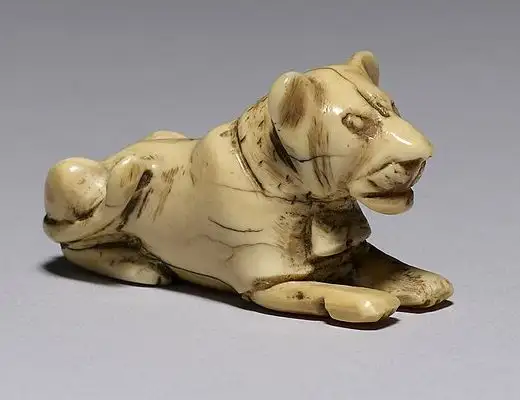
Ivory lioness, a gaming piece of the kind associated with Mehen. Hippopotamus ivory, about 3000–2900 BC, possibly from Abydos. Walters Art Museum, Baltimore, accession 71.623. Photograph by the Walters Art Museum, cropped, CC BY-SA 3.0, via Wikimedia Commons.

At first, I imagined that perhaps six people raced six marbles each along the serpent. The numbers fit neatly enough. But the more I thought about it, the less practical that seemed.
Some surviving Mehen boards have well over a hundred spaces. Racing 36 individual marbles along such a board could take an extraordinary amount of time.
And the lions?
They are much larger than the individual spaces on surviving boards. If they were supposed to move along the serpent’s body, many would occupy several spaces at once. That raises obvious questions about overlapping pieces, blocking, and capturing.
I found James F. R. Masters’ research particularly helpful here.
In his 2023 paper, Mehen, the Ancient Egyptian Serpent Game: A Reappraisal of Game-play Theories, Masters evaluates proposed mechanics against the actual dimensions of surviving equipment and the practical requirements of gameplay.
His analysis casts serious doubt on the idea of independently racing the lion figurines around the track.
His 2024 reappraisal also examines archaeological evidence that has sometimes been misrepresented in earlier studies.
One especially interesting depiction comes from the tomb of Rashepses. It appears to show two lion figures near the central area of the board, oriented toward pieces being handled by players.
Their exact function remains unknown.
Maybe they were guards. Maybe they were markers. Maybe they belonged to individual players. I found the possibility that they were positioned at the center particularly fascinating, since the shape of the board seems to invite some relationship between its head and whatever the lions represented.
Another scene, from the pyramid complex of Sahure, depicts three people on either side of a Mehen board. That suggests the possibility of a social or team game, although the scene cannot tell us whether everyone was playing, advising, or merely watching.
The evidence gives us equipment and possible arrangements, but not the system connecting them.
I kept returning to the same question: why six lions, and why so many marbles?
A serpent that protects
Mehen is also the name of an Egyptian protective serpent deity, often translated as the Coiled One.
In Egyptian religious tradition, Mehen is associated with protecting the sun god Ra during his passage through the darkness.
Peter Piccione’s 1990 paper, Mehen, Mysteries, and Resurrection from the Coiled Serpent, examines connections between the serpent, Egyptian funerary texts, and the journey toward rebirth.
Later religious literature includes descriptions of the Roads of Mehen, a series of passages associated with knowledge, protection, and the afterlife.
I found this association especially interesting because it changes how one might interpret the board. Rather than a race across an arbitrary spiral, the journey could symbolize passage through a protective serpent.
Of course, we have to be careful here. Some of these religious texts were written centuries after the earliest Mehen boards. They help explain what the serpent eventually meant within Egyptian religion, but they don’t establish what the original players believed the game represented.
Still, the relationship between the physical board and the serpent’s symbolic role is difficult to ignore.
It made reaching the head feel like a more appropriate objective than simply racing to the end of a track and returning to the tail.
We initially considered an outward return journey, but eventually dropped it.
For this interpretation, reaching the serpent’s head would complete the journey.
What if there were no dice?
One of the more surprising things I learned was that no throwing sticks or dice have been securely associated exclusively with Mehen.
This doesn’t prove that they weren’t used. Throwing sticks have been found in assemblages containing equipment for multiple Egyptian games, including Senet. But the evidence doesn’t establish them as Mehen’s movement mechanism.
That left an interesting question: how did players determine how far their pieces traveled?
One theory, proposed by earlier scholars and examined experimentally by Masters, is that players concealed marbles in their hands while an opponent attempted to guess how many they were holding.
The result of that guess could determine movement.
It’s a simple mechanism, but one that seemed surprisingly plausible given the equipment and certain gestures depicted in scenes of Mehen play.
And unlike dice, it introduces an element of psychology.
Suppose I conceal five marbles. If you guess incorrectly, perhaps I can advance five spaces. But if you correctly anticipate my choice, something unfavorable happens to me.
Now I have a decision.
Do I conceal five because I want to travel quickly? Or do I conceal two because you expect me to choose a high number?
You might know that I’m close to finishing and predict a large movement. I might anticipate that prediction and deliberately choose a smaller one.
That was the point where I became interested in designing my own interpretation.
I didn’t know whether this was how the ancient Egyptians played Mehen. But it seemed like a promising foundation for an enjoyable game.
Designing with six marbles
I started with six marbles per player, inspired by the six-marble groups depicted in Hesy-Ra’s tomb.
Originally, I considered using the marbles only for guessing and movement, with separate pieces racing along the serpent.
But then I wondered: what if they were the same pieces?
Each player would begin with six marbles in reserve. They could conceal any number from one to six, and their opponent would guess that amount.
On an incorrect guess, they could advance an existing piece or commit a marble from their reserve to the serpent.
Committing a marble removes it from their guessing pool for as long as it stays on the serpent.
So after deploying one marble, a player would have only five available numbers to conceal. Deploying a second would reduce that to four.
This introduces a tradeoff between progress and flexibility.
A player who hasn’t deployed anything can conceal between one and six marbles. Each marble on the serpent is one fewer number they can hide.
| On the serpent | In hand | Correct guess |
|---|---|---|
| None | 6 | 1 in 6 |
| One | 5 | 1 in 5 |
| Two | 4 | 1 in 4 |
If both players choose uniformly at random, a correct guess only becomes a little more likely, from about 17% to 25%. That doesn’t sound like an enormous difference, but over a long race it can become consequential.
And players aren’t choosing numbers uniformly at random. They’re making decisions based on how far they want to move and what they think their opponents expect.
I initially considered requiring three marbles to reach the serpent’s head, then six. But that seemed excessive, especially since each new traveler reduces the number of available movement values.
Eventually, I settled on two.
The goal became to deliver two marbles to the serpent’s head while managing the diminishing pool used to conceal movement.
This wasn’t derived from an Egyptian inscription or an excavated rulebook. It was a game-design decision.
But I liked how it made the marbles serve several purposes with very few rules.
The lions
The lions were the most difficult component to interpret.
We know lion and lioness figurines were associated with Mehen. Their large size makes ordinary movement along the narrow track questionable. Their positioning in some depictions is intriguing, but their purpose remains uncertain.
I considered giving them attacking abilities, or perhaps having them guard particular regions of the serpent.
But I couldn’t arrive at an explanation that felt sufficiently grounded in the evidence.
Eventually, I decided they could represent protection or survival.
Each player would begin with three lions.
If an opponent correctly guessed the number of marbles concealed, one of the active player’s lions would fall.
If all three lions fell, that player would lose.
But a player whose hidden number wasn’t guessed correctly could choose to restore a fallen lion instead of moving a marble.
This produced another tradeoff.
Do I use a favorable guess to advance toward the serpent’s head, or recover a lion and make myself safer?
It also meant that the game had two routes to victory: successfully completing the race or exhausting the opponent’s protection.
I liked that because the race and the guessing game could pressure one another.
The lions themselves would remain outside the serpent, facing inward when active and turning away when fallen.

Two lions still face the serpent. The third has turned away.
There’s no archaeological evidence that lions represented lives, could be turned to indicate defeat, or could be restored through guessing.
This is probably the most liberal part of my reconstruction.
But the resulting mechanic was simple, visible, and made the otherwise mysterious figurines important to every match.
I also added capturing. Landing exactly on an opposing marble sends it back to its owner’s pile, so it can be entered again. Friendly marbles can be passed over and can share a space.
This creates opportunities to interfere with an opponent’s progress without adding much additional complexity.
Again, it’s a modern design choice, not a recovered Mehen rule.
What about six players?
The original equipment still bothered me.
Six groups of six marbles. Three lions. Three lionesses.
If Mehen was played by six people, what would that game have looked like?
One possibility I considered was two teams of three, with each participant controlling six marbles and one lion.
That would account for all 36 marbles and six figurines.
Of course, that numerical correspondence does not prove the game was arranged this way.
But it gave me a starting point for a six-player variation.
Each person would have one marble to race toward the serpent’s head. The teams would alternate turns, with each participant acting once per round.
A correct guess would freeze the acting player, turning their lion away from the serpent. Their marble would remain on the board, unable to advance.
On an incorrect guess, a teammate could choose to move or revive someone who had been frozen.
Essentially, a game of freeze tag layered onto a race.
This introduced an element I hadn’t anticipated in the two-player version: cooperation.
Imagine one teammate almost reaching the serpent’s head, only to be frozen. Another teammate must decide whether to advance their own marble or sacrifice their opportunity to revive the player who’s nearly finished.
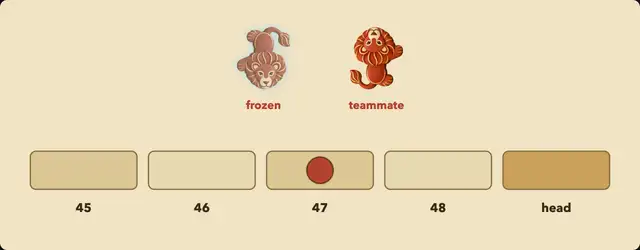
One player is close to the head and frozen. A teammate can still move.
And the opposing team gets to discuss the hidden number together. I imagine that being part of the fun: people calling out guesses, arguing about what their opponent might be concealing, and cheering when someone finally gets it right.
I decided that two different teammates reaching the head would win.
To make the remaining journey more dangerous, after one teammate finishes, the other two permanently lose one marble from their guessing reserves.
A finished player can still help revive their teammates, so completing a journey doesn’t necessarily mean sitting out the remainder of the game.
I suspect the six-player variant might be particularly enjoyable socially, even if keeping one person as a dedicated support player turns out to be a strong strategy.
It is quite a different game from the two-player version, despite using essentially the same mechanics.
Making it playable
I implemented the game for my website, with both two-player and six-player modes, human and AI players, and two board lengths.
The Compact board has 49 spaces. The Extended board has 127, inspired by a surviving Mehen board in the collection of the University of Chicago’s Institute for the Study of Ancient Cultures.
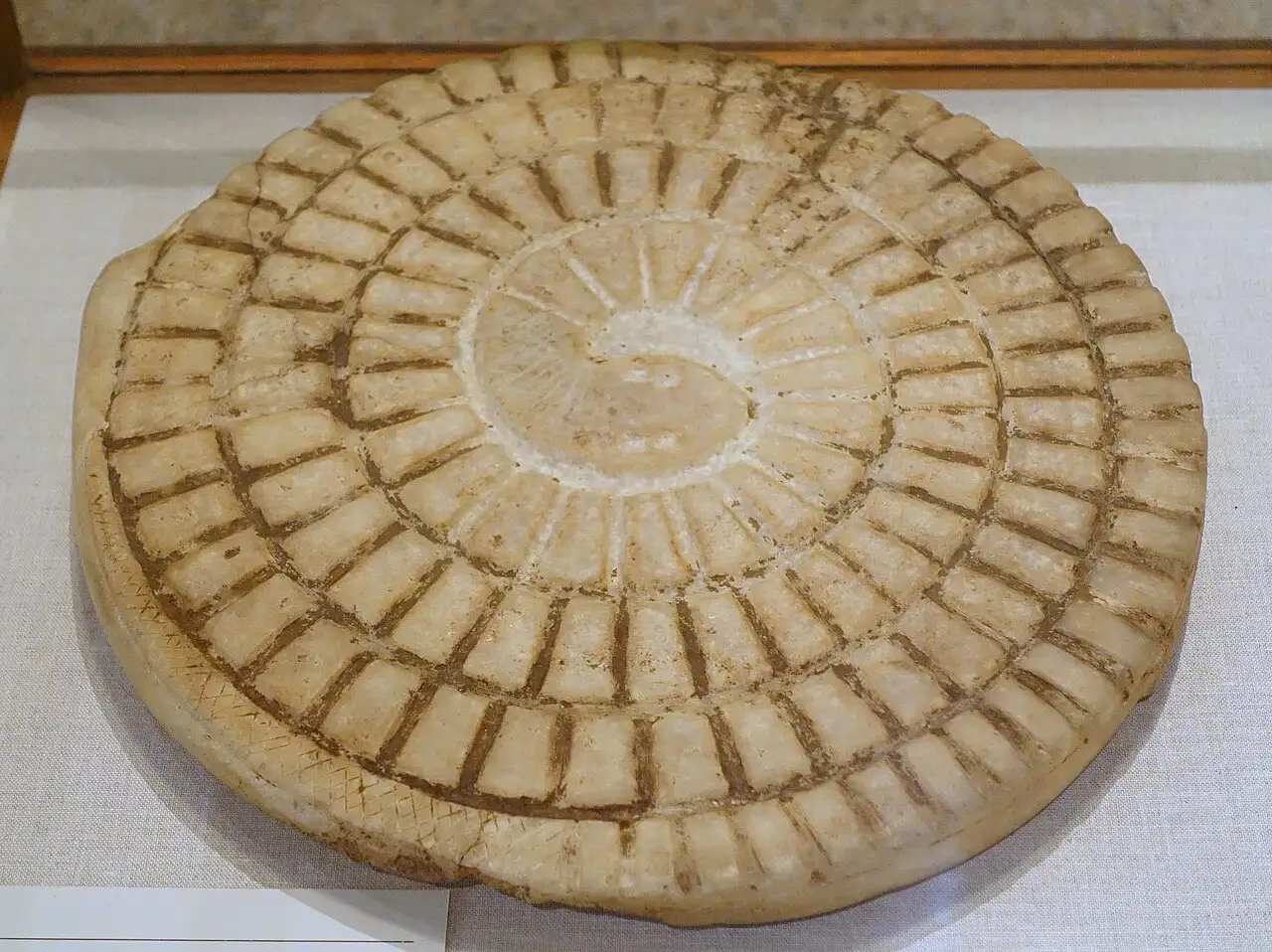
Mehen board, alabaster, Old Kingdom, about 2750–2250 BC. Institute for the Study of Ancient Cultures, University of Chicago, OIM E16950. Photograph by Daderot, CC0, via Wikimedia Commons.

The artwork takes a more modern direction than the surviving stone boards, such as Chicago’s and the one in the Fitzwilliam Museum. I wanted something that felt like a contemporary abstract strategy game while retaining the visual identity of the coiled serpent.
The result is a painted, textile-like board with a tightly wound serpent and small lion and lioness pieces arranged around its perimeter.
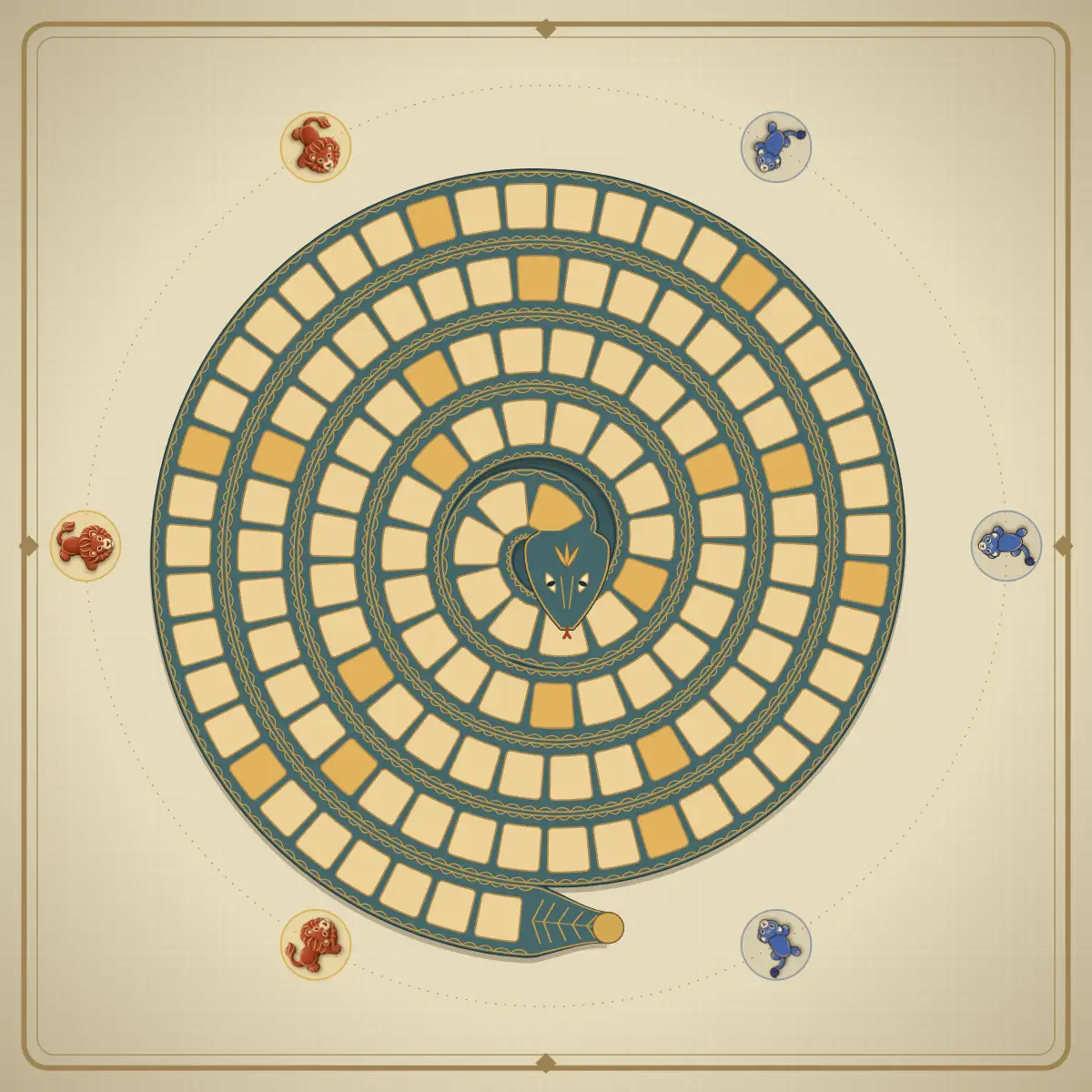
The Extended board in the game. The lions stay off the track, and the head is at the center.
Getting that serpent to look right was unexpectedly difficult.
In particular, I spent an unreasonable amount of time getting the final coil to connect naturally to the serpent’s head. Several attempts either left a gap, made the head enormous, or turned the neck into something resembling a garden hose.
Eventually, it came together.
The computer opponents are intentionally simple. They use basic heuristics for advancing, capturing, and recovering, with randomized hidden numbers and guesses.
I’ve played some rounds against the AI, and most of the games I’ve observed have ended through lion elimination rather than both marbles completing their journeys.
I still find the game strategic. There’s a tension between advancing quickly, preserving lions, and predicting what the other player is likely to hide.
But I suspect playing against other people will be a different experience.
The AI’s guesses are imperfect and somewhat random. Human players might begin to recognize each other’s habits, bluff about their intentions, or deliberately become unpredictable.
That’s where I think the hidden-marble mechanic has the most potential.
I may eventually introduce AI difficulty settings that model an opponent’s tendencies, but for now, I want to see how people play.
Research, AI, and reconstruction
I should also mention how I worked on this project.
I used ChatGPT extensively to help investigate the surviving evidence, find archaeological publications, compare different interpretations, and reason through possible mechanics.
Having an assistant surface relevant academic work, original excavation documentation, and museum records made it much easier to explore an unfamiliar subject.
I have a cursory familiarity with Egyptian mythology and history, but ChatGPT helped me explore the subject far more deeply than I could have on my own in such a short time. It brought together archaeological sources, religious beliefs, and their respective historical timelines, helping me distinguish later interpretations from beliefs contemporary with the game and consider whether my invented mechanics were at least culturally and historically plausible, even if ultimately speculative.
It was also useful for the arithmetic behind some design decisions. How often might an opponent guess correctly? What happens when the number of possible hidden values shrinks? How long might a race take on a board with over a hundred spaces?
These are simple questions individually, but considering them together helped identify potential problems before implementing everything.
I used Cursor and AI coding tools to develop the browser implementation and iterate on the presentation.
That collaboration accelerated the process considerably, but it also made the distinction between evidence and invention especially important.
An AI-generated explanation can sound convincing without being correct. I tried to ground historical claims in identifiable publications and archaeological sources, and to distinguish those claims from the conclusions and mechanics I was developing.
The game-design decisions were ultimately judgments about what I found interesting, plausible, and potentially enjoyable.
I don’t think using AI to investigate an unfamiliar subject removes the responsibility to understand what you’re making claims about.
If anything, it makes that responsibility more important.
Reconstruction or invention?
I began this project wanting to understand how Mehen might have been played.
I ended it with a game that probably differs substantially from the original.
And I’m comfortable with that.
The surviving archaeological evidence gave me a serpent board, marbles, lion figurines, and scenes of people interacting with the game.
Research into its possible mechanics suggested hidden-marble guessing and a race toward the serpent’s head.
Egyptian religious traditions provided a possible symbolic context involving protection, passage, and renewal.
Beyond those clues, I had to make decisions.
I chose two travelers instead of six. I connected the guessing reserve to the racing pieces. I made lions represent survival, added recovery, introduced capturing, and built a team variation around freezing and reviving players.
These choices produced something playable, but they aren’t evidence of what ancient Egyptians actually did.
I think that’s an interesting distinction in designing historically inspired games.
Sometimes we have enough documentation to reproduce a game with reasonable confidence. Other times, we have fragments of a system and must decide what to do with the missing pieces.
With Mehen, I wanted to respect the fragments without pretending they formed a complete picture.
The result is Edgar San Martin Jr.’s Mehen, my own interpretation of an ancient game whose rules have been lost.
You can play it here or read the complete rules.
I’m curious how the game will develop once other people play it, especially the six-player variation.
And I’m still wondering what those lions were actually for.
Further reading
- Walter Crist, Anne-Elizabeth Dunn-Vaturi, and Alex de Voogt — Ancient Egyptians at Play (2016)
- James F. R. Masters — A Reappraisal of Game-play Theories (2023)
- James F. R. Masters — A Reappraisal of the Evidence Set (2024)
- Anne-Elizabeth Dunn-Vaturi — Board Games from Ancient Egypt and the Near East (2018)
- Peter A. Piccione — Mehen, Mysteries, and Resurrection from the Coiled Serpent (1990)
- James E. Quibell — The Tomb of Hesy (1913)
- Fitzwilliam Museum — Mehen Game Board
- University of Chicago — Ancient Egypt: Treasures from the Collection of the Oriental Institute